|
Aadim Nepal I graduated from NYU Abu Dhabi with a double major in Mathematics and Computer Science. I am currently a junior research scientist there, advised by Professor Keith Ross. I work on energy-based models for online decision-making, with an emphasis on agents that learn to plan and adapt through interaction. I also collaborate closely with Yilun Du at Harvard. I am looking for PhD opportunities beginning Fall 2027. Email / CV / Scholar / Twitter / GitHub / Blog / Miscellaneous |

|
Recent News
Aug 2026
Decomposed Contrastive Critics for Continual Reinforcement Learning appeared at the Continual Reinforcement Learning Workshop at RLC 2026.
Dec 2025
Layer Importance for Mathematical Reasoning accepted at the NeurIPS MATH-AI Workshop 2025.
Nov 2025
Presented Layer Importance for Mathematical Reasoning and Warm Up Before You Train at EMNLP 2025 in Suzhou, China.
Nov 2025
Warm Up Before You Train accepted at EMNLP 2025 main!
Oct 2025
Layer Importance for Mathematical Reasoning accepted at EMNLP BlackboxNLP 2025.
Jul 2025
Presented Multimodal Deep Learning for Stroke Prediction at EMBC 2025 in Copenhagen, Denmark.
Mar 2025
Multimodal Deep Learning for Stroke Prediction and Detection using Retinal Imaging accepted at EMBC 2025!
Jan 2025
Started my senior thesis with Prof. Keith Ross at the Deep Learning Lab, NYU Abu Dhabi, working on LLM interpretability and reasoning.
Jun 2023
Summer research at the Center for Cosmology and Particle Physics, NYU (New York), studying radio emissions of supermassive black holes using VLBA telescope data with Prof. Ingyin Zaw and Prof. Joseph Gelfand.
|
ResearchMy research asks how energy-based models can support planning and online decision-making. I combine generative models, world models, and reinforcement learning to build agents that learn from interaction and reason over possible futures. Most of my published work is in LLM reasoning and interpretability, which I began in Professor Keith Ross's lab. As I developed my own research direction, I returned to energy-based models, which first interested me in Yann LeCun's course, and shifted toward online decision-making and planning. I am very grateful to Professor Ross for giving me the freedom and support to pursue the ideas that interest me. I view LLMs as useful tools, not a complete model of intelligence, and now work on online EBM planning with Yilun Du and Professor Ross. Selected publications are highlighted in yellow; current research projects are labeled separately. |
Current Research |
|
|
EBM PLANNING
|
CURRENT RESEARCH PROJECT
Online Energy-Based Trajectory Planning Aadim Nepal, Yilun Du*, Keith Ross* Ongoing work, 2026 We are exploring a modular view of reinforcement learning in which different parts of the decision process are represented by distinct learned energy functions. As experience accumulates, these energies can be updated and composed to guide trajectory-level planning, support diverse plans, improve exploration, and adapt online as the model of the environment changes. |
Selected Publications |
|
|
+
−
DCC
|
Decomposed Contrastive Critics for Continual Reinforcement Learning
Yumi Omori, Zixuan Dong, Aadim Nepal, Ashok Timsina, Keith Ross Continual Reinforcement Learning Workshop at RLC, August 2026 paper We decompose a goal-conditioned contrastive critic into a shared component learned across tasks and a task-specific component reset for each new task. On the hardest Continual World V2 tasks, this improves performance by 67% and 78% over naive contrastive approaches. |
|
Layer Importance for Mathematical Reasoning is Forged in Pre-Training and Invariant after Post-Training
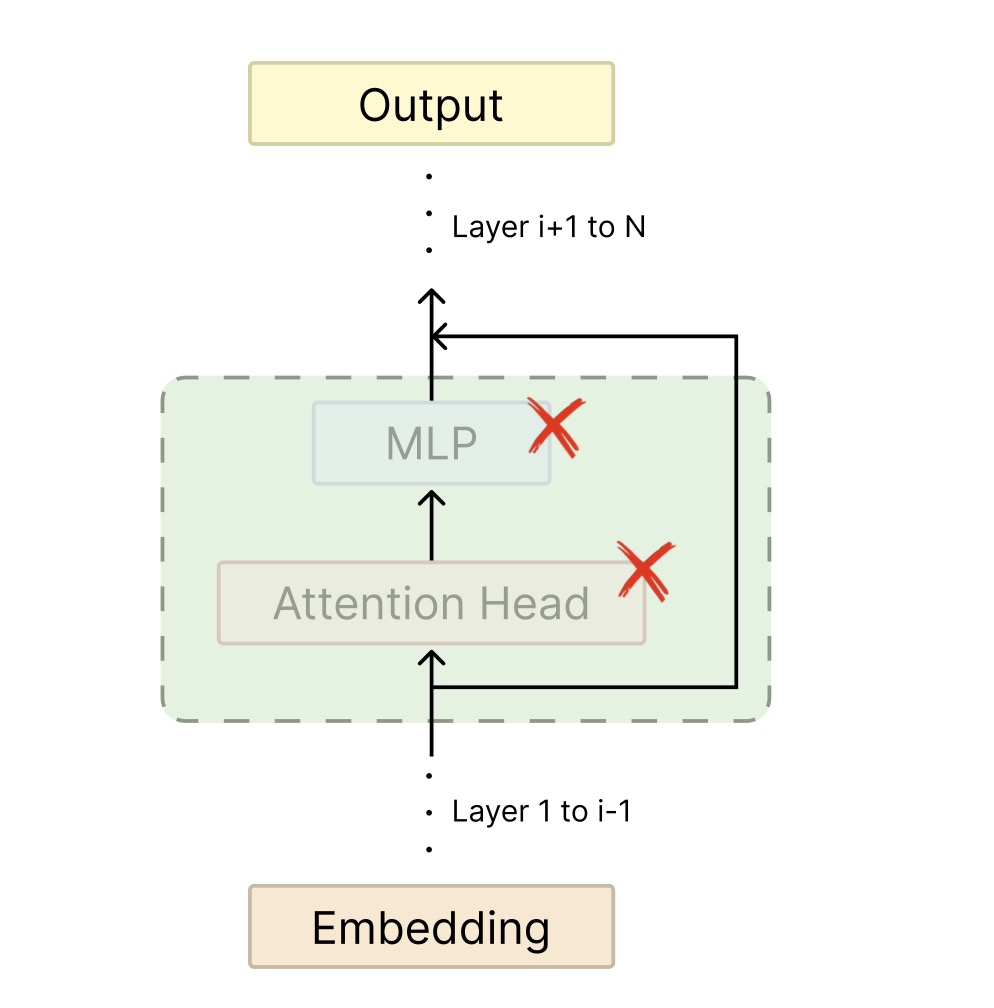
Aadim Nepal, Safal Shrestha, Anubhav Shrestha, Minwu Kim, Jalal Naghiyev, Ravid Shwartz-Ziv, Keith Ross The 5th Workshop on Mathematical Reasoning and AI at NeurIPS, 2025 arXiv We find that a small number of layers are responsible for most of the mathematical reasoning ability in LLMs. These layers form during pre-training and do not change after post-training, regardless of the method used. Removing them drops math accuracy by up to 80%, while factual recall is spread more evenly across layers and holds up better. |
|
Warm Up Before You Train: Unlocking General Reasoning in Resource-Constrained Settings
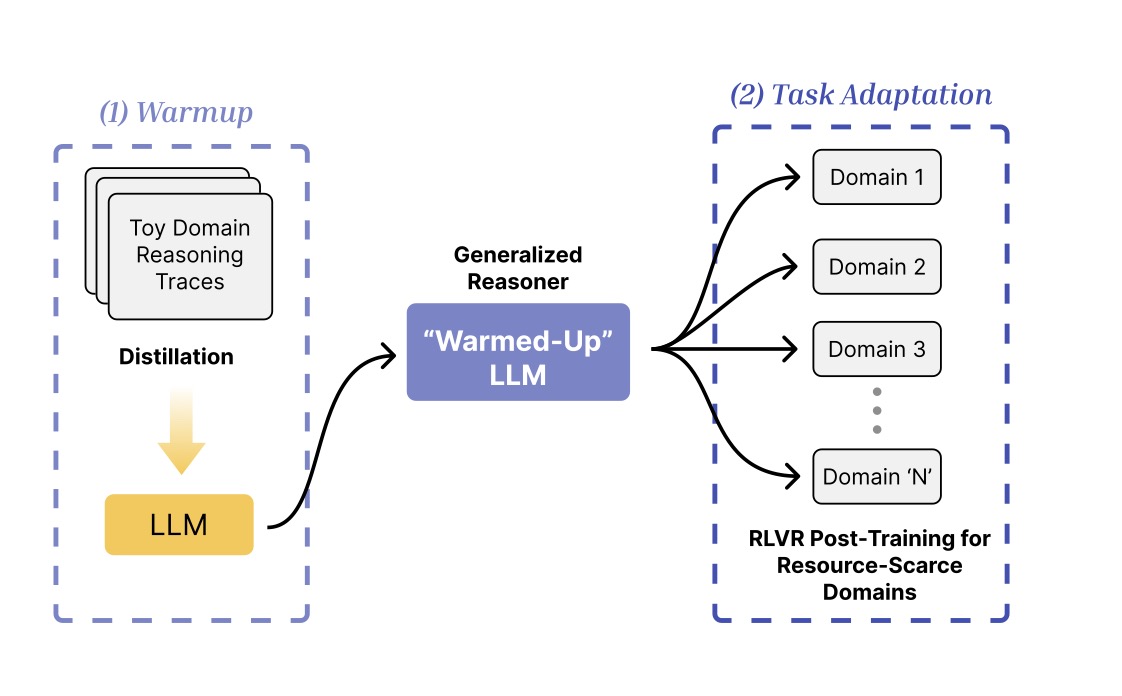
Safal Shrestha, Minwu Kim, Aadim Nepal, Anubhav Shrestha, Keith Ross EMNLP, 2025 arXiv We show that training on simple logic puzzles before applying RLVR helps models learn to reason more effectively. This warm-up step improves performance even with limited data and compute, making it a practical approach for resource-constrained settings. |
|
Multimodal Deep Learning for Stroke Prediction and Detection using Retinal Imaging and Clinical Data
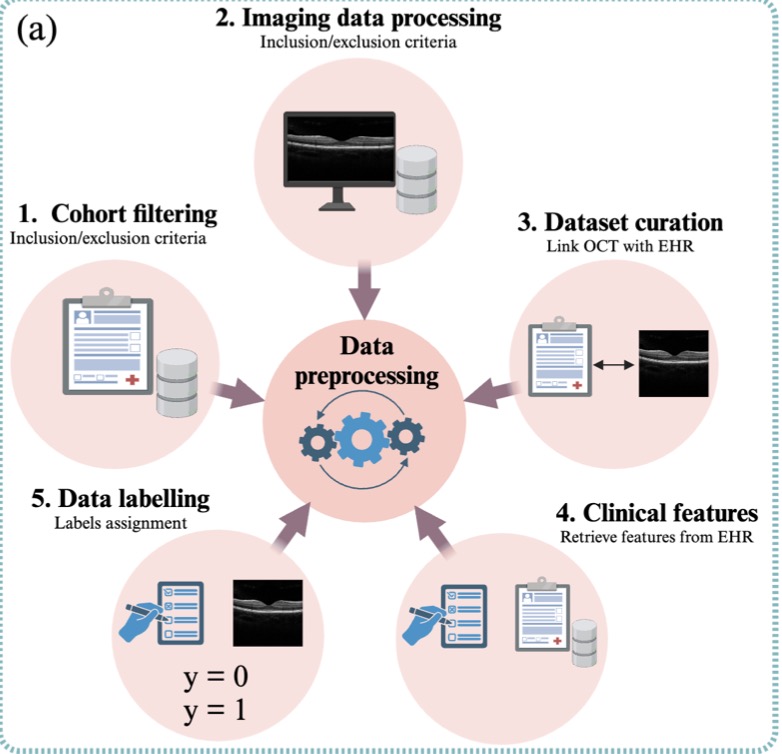
Saeed Shurrab, Aadim Nepal, Terrence J. Lee-St. John, Nicola G. Ghazi, Bart Piechowski-Jozwiak, Farah Shamout EMBC, 2025 arXiv We build a multimodal model that combines retinal OCT scans, infrared fundus images, and clinical data to predict and detect stroke. Using all three modalities together improves AUROC by 5% over image-only models and by 8% over existing retinal foundation models. |
|
Website template from Jon Barron. |